


Brew Guide:
Best Brewed with: Espresso
Medium-Light Roaster Influence: We find classic Brazilian coffees benefit from a much slower overall roast time when compared to our light and bright filter options - often as much as 2-3 minutes longer compared to our fast roasts. This slower roast prevents roast defects, allows us to use lower overall temperatures, a shorter end of roast period relative to some espressos, and really emphasises body and roast-influence derived sweet caramels.
Best Rested: 3 weeks
For Filter: We recommend a ratio of 65g/L and 88°C water
For Espresso: 18g in, 40g out, 30-35s for a classic style of espresso. Could turbo, we prefer trad for this.
We're tasting:
Sweet high quality dark chocolate aromatics and amaretto. In the cup it's high quality dark chocolate, blackberry jam, praliné crème mousseline, pomegranate molasses, with a cakey sweet marzipan note that's uncannily like Battenberg cake. Core Brazil flavours with a delightful lift, and not requiring a super dark roast to hit.
In milk: milk chocolate, honeycomb (like a crunchie bar), date syrup
Traceability
Country of Origin: |
Brazil |
Region: |
Espírito Santo do Pinhal, Mogiana |
Producer: |
Patricia Coelho |
Farm: |
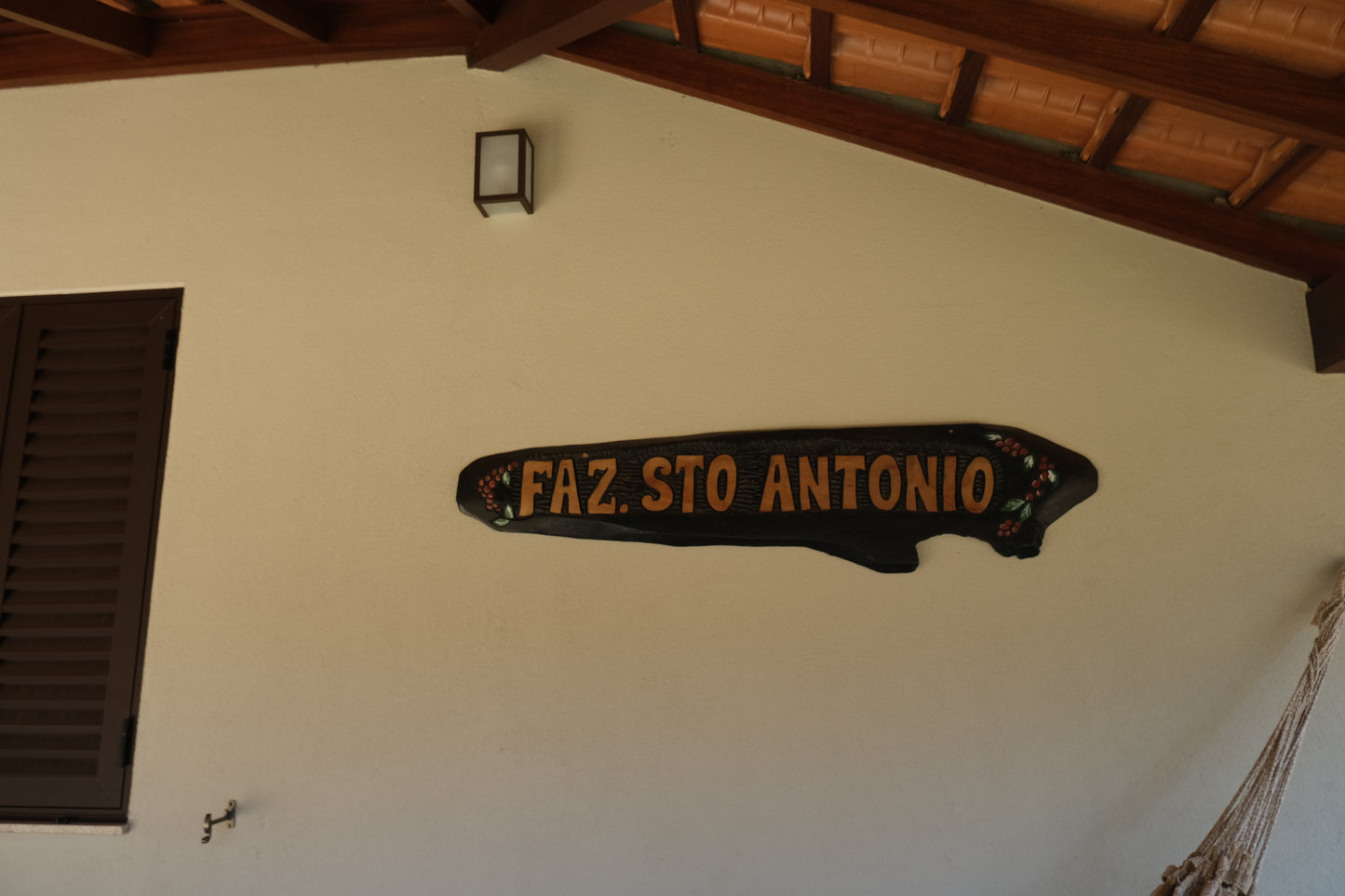
Fazenda Santo Antônio |
Variety: |
Mundo Novo |
Elevation: |
1050 - 1300 MASL |
Process: |
"Induced Fermentation" Natural: Cherries picked and taken to central processing point, and placed in 1 ton open bulk bags. The cherries are dry fermented, with both surface yeasts and enzymatic fermentation driving this initial, "induced" step. After 24 hrs, the cherries were then spread in very thin layers to dry with turning every 8 hrs - preventing over-fermentation - and once reaching a lower moisture content with minimal microbial activity, the final stage of drying occured in "normal" thickness layers before a reposado in-husk in wooden conditioning bins.
|
Import Partner: |
Bossa Coffee |
Harvest |
Crop 25/26, Arrived UK 24 Nov 2025 Second harvest purchasing from Patricia |
The Story
We first encountered Patricia Coelho's coffee through abject need. When our planned Brazilian lots from Poços de Caldas and Fazenda Recreo ran late arriving earlier this year, we needed cover for the Facility blend - right smack in the middle of a record high commodity market. The peaberry lot from Patricia delivered quality worth its considerable cost, which mattered when paying premium prices for what might have been merely functional supply.
That season happened to coincide with Patricia planning her first separated microlot production - an activity that during record commodity prices runs counter to typical economic logic. When the C-market sits above $4.00/lb, specialty premiums compress significantly in percentage terms. A Brazilian producer can mechanically harvest their entire crop and sell everything at historically high rates with minimal labour input and no fermentation risk, or they can hand-pick selectively (or aggressively optically sort), separate lots, invest additional processing time, and potentially earn 15-25% more on successful lots whilst absorbing losses on failed experiments. Certainly the most economically rational choice for a capitalised Brazilian producers is the former path. Patricia's decision to begin experimenting during this period suggests motivations beyond immediate margin optimisation - a love of speciality and quality production, though we cannot speak to her specific reasoning.
Her choice of Mundo Novo for these first experiments makes practical sense as a risk mitigation strategy. The variety represents the workhorse of Brazilian production, reliable and well-understood, rather than the higher-value cultivars she grows elsewhere on the property. Using an established, lower-cost variety for initial higher intervention processing limits downside exposure if fermentation trials fail to deliver specialty quality.
Fazenda Santo Antônio sits in the Mogiana region near Espírito Santo do Pinhal, where Patricia operates at elevations reaching 1300 metres. The specific distinction of this area is that coffee production exists alongside serious viticulture. Vinícola Guaspari, considered amongst Brazil's finest wineries, operates in the same municipality, having transformed from coffee production to wine whilst maintaining both crops. This is not coincidental overlap but reflects shared requirements: altitude, significant thermal variation between day and night temperatures, and mineral-rich volcanic soils that support both coffee and wine grapes. More significantly, this proximity creates knowledge transfer pathways where fermentation science developed for wine production can inform coffee processing experimentation.
Patricia's induced fermentation method reflects this influence, though we should note this is our theoretical framework rather than confirmed methodology. The process places picked cherries into one-ton open bulk bags for twenty-four hours prior to treating them as naturals. We theorise that the weight of accumulated cherries would crush those at the bottom of the bag, similar to how grapes at the base of a fermentation vessel rupture under the mass of fruit above during Beaujolais production. This mechanical rupture would trigger enzymatic fermentation within intact cherries whilst simultaneously releasing sugary liquid that surface yeasts can metabolise. The subsequent aggressive thin-layer drying with regular turning arrests fermentation before it progresses into defect territory, followed by conventional drying once microbial activity has diminished, finishing with wooden bin conditioning.
What this achieves is additive complexity on a neutral varietal base. Mundo Novo's typical profile delivers chocolate, caramel, and body with modest acidity. The fermentation intervention introduces layered fruit character and textural depth without fundamentally altering what makes this recognisably Brazilian coffee. It extends rather than transforms, which describes the practical value proposition: all the expected functionality for winter espresso profiles, with sufficient additional character to distinguish it from volume commodity whilst remaining accessible rather than experimental in the cup.
This represents our second year purchasing from Patricia, moving from reactive cover buying to deliberate relationship building. The broader context worth noting is how cover lot purchasing can surface quality that curated sourcing might miss. When procurement operates within established supplier relationships and pre-determined quality expectations, there is limited opportunity to discover producers beginning to develop specialty capability. Cover buying - driven by supply necessity rather than quality selection - creates accidental exposure to producers like Patricia who are investing in differentiation during periods when conventional economic incentives suggest they should not bother.
Whether her experiments continue, scale up, or revert to bulk production will likely depend on how commodity markets evolve. If prices normalise downward to $2.50-3.00/lb as forecasts suggest, specialty premiums will again represent meaningful percentage gains rather than compressed absolute differentials. Producers who have built buyer relationships and demonstrated processing capability during high-price periods will be positioned to capture those premiums when the market structure shifts back in specialty's favour. For now, we have winter espresso that works exceptionally well for its intended application, sourced from a producer whose strategic direction remains interesting to observe.
- Choosing a selection results in a full page refresh.
- Opens in a new window.