


Brew Guide:
Best Brewed with: Espresso, Immersion (Aeropress/French Press), Moka pot
Medium-Light Roaster Influence: Looking back to our first year roasting this coffee, we're roasting this crop with an overall slower, softer approach - getting our some of our development early with a more even roast, and stretching that final stage longer (shaving off some of the punchy acidity these lots can posses) while also keeping the overall end temperature down (reducing any pointed/sharp) funk.
Best rested for: 2-3 weeks
For Filter: We recommend a ratio of 65g/L and 94°C water
For Espresso: 18g in, 42g out, 30-35s for a classic style of espresso. Can also pull 18g / 50g / 20-25s turbos
We’re tasting: Super fun aromatics - raspberry kombucha, green banana & cacao nib. In the cup it's bright, juicy & tropical - we're getting passionfruit, fruit pastilles, pineapple, Riesling wine, with some of that classic Burundi baking spice. As it cools, we get orange glucose sweets, watermelon gummies & milk chocolate.
In milk - passionfruit, pineapple, & banana foam sweets.
We're tasting:
Super fun aromatics - raspberry kombucha, green banana & cacao nib. In the cup it's bright, juicy & tropical - we're getting passionfruit, fruit pastilles, pineapple, Riesling wine, with some of that classic Burundi baking spice. As it cools, we get orange glucose sweets, watermelon gummies & milk chocolate.
In milk - passionfruit, pineapple, & banana foam sweets.
Country of Origin: |
Burundi |
Region: |
Kibingo, Kayanza province |
Farm: |
1346 smallholders selling cherry to Kibingo |
Station: |
Kibingo CWS, Greenco |
Variety: |
Red Bourbon |
Elevation: |
Grown at 1700 -1900 MASL, Processed/Dried at 1,893 MASL |
Process: |
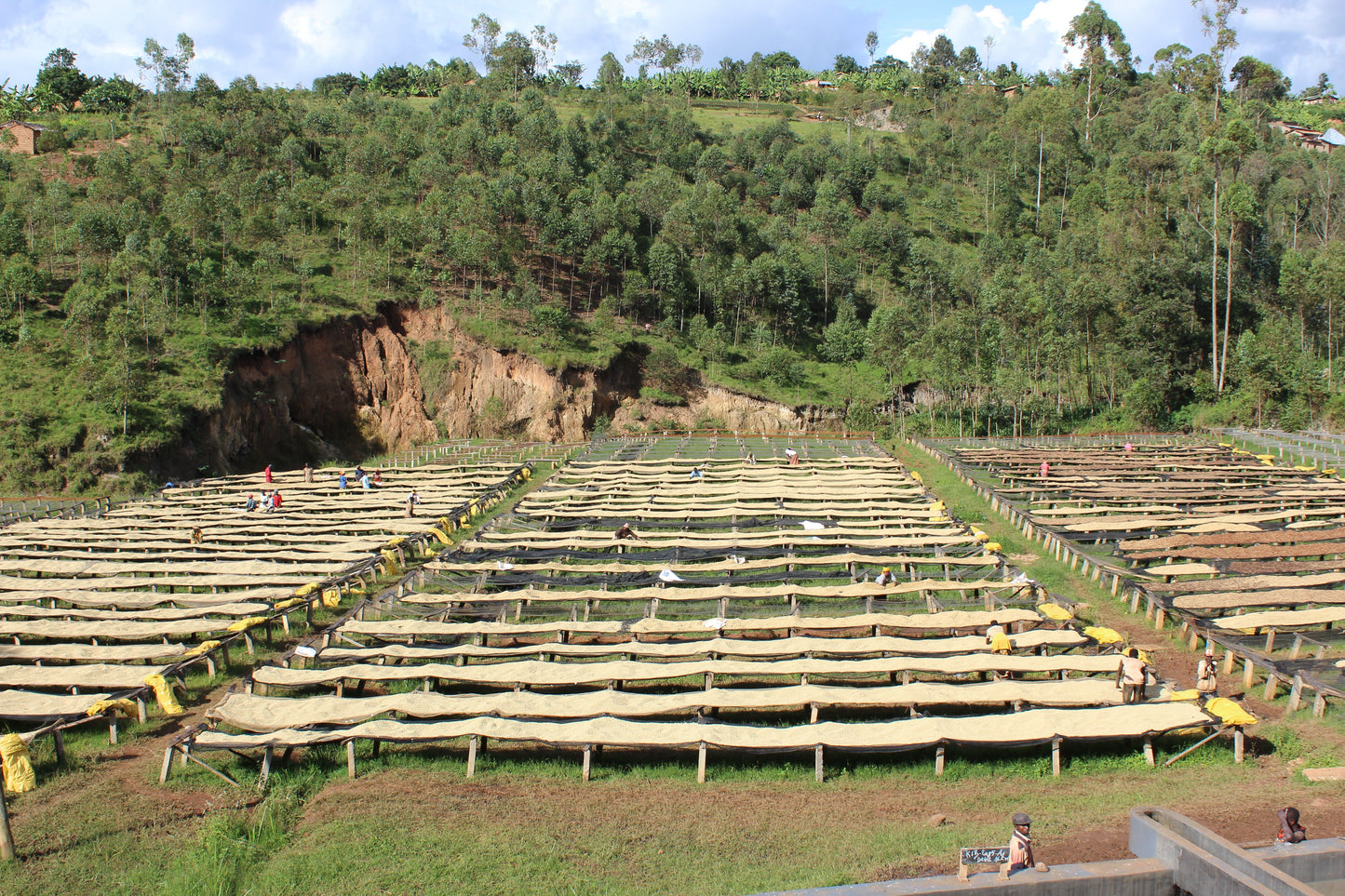
Yeast Inoculated Natural: Cherries selectively picked and delivered on foot/bicycle to Kibingo CWS, with floatation on arrival. Cherries transferred to covered (but not sealed) tanks and inoculated with the coffee specific LALCAFÉ INTENSO™ yeast (S. cerevisiae), with a 36 hour aerobic fermentation. Cherries then drained and laid out to dry on raised beds for 3 weeks until reaching a stable moisture content, bagged and stored with a several week rest in husk prior to hulling. |
Import Partner: |
Sucafina |
Harvest |
Crop 25/26, Arrived UK Feb 2025 Fourth harvest purchasing coffee from Kibingo smallholders. |
The Story
Kibingo is a relatively large-scale washing station, situated in Kayanza, northern Burundi. It serves as a central hub for 1346 registered coffee growers across 18 surrounding hills, with farm altitudes reaching up to around 1900 metres. The farmers are organised into groups, each led by a farm leader who facilitates communication and coordination with the washing station. The station takes its name from the Kirundi word urubingo, the reeds planted along the riverside running through the grounds, which drain north toward the Nile basin.
The station is well-equipped for bulk coffee processing, with fermentation tanks, soaking tanks, and a large complement of drying tables. It also provides essential resources to the farmers, such as organic fertiliser made from composted coffee pulp and low-cost coffee seedlings nurtured in the station's own nursery, grown from certified seed-stock sourced through ISABU, the Institut des Sciences Agronomiques du Burundi, and sold to farmers at or below cost. Greenco, the independent station management company that has operated Kibingo since 2015, maintains agronomists at each of its stations year-round to support this work.
In terms of cultivation, the majority of coffee trees in the region are Red Bourbon, introduced during the Belgian colonial period through Catholic mission networks, most likely via Réunion, and cultivated in Kayanza for the better part of a century. As a germline, Red Bourbon is well-established in Burundian growing conditions at this altitude, and Kibingo itself has placed in the country's Cup of Excellence programme on multiple occasions, including a Presidential Award in 2017. Farmers face real challenges due to ageing rootstock and small plot sizes, which make it hard to renew plantations without taking a significant loss of income, because taking trees out of production, even ageing ones with declining yields, is a direct hit to households with very few alternative revenue streams. It is the ability to offer differentiated and nuanced profiles, as well as providing added value to bulk production, that has brought us back to the Kibingo yeast lots.
A yeast inoculated coffee from the Kibingo station formed the centrepiece of our green buyer and co-founder Alex's 2019 United Kingdom Barista Championship routine, focused around the concept of elevating "classic" and lower scoring coffees to improve farmer livelihoods. In the years that have passed since then, yeast processing in coffee has taken off, with both commercially available yeasts for bulk processing, and better resourced farmers (typically in Colombia) isolating local strains with positive characteristics.
All of this can be seen to be operating almost as a reverse of the wine industry's "natural wine" movement. Spontaneous fermentation in wine allowed new and unusual sensory characteristics to be expressed in the final product, but at the risk that some of the harvest would be sub-par, allowing a generation of vignerons to rebel against the overly technical and controlled nature of the mature wine industry.
Coffee, as a relatively young industry when it comes to the technical skills of fermentation, is starting from a place where a decade or so back, 100% of coffee was fermented using spontaneous fermentation, using wild yeast and bacteria present at the mills to both aid processing as well as improve the sensory attributes of the final cup. All the while introducing an element of random variability (and risk) in the final product. Some years, a coffee could be outstanding, a Cup of Excellence winner and a boon to the farmers, the next crop a blender (or worse).
As the coffee industry matures, each year brings new and higher technical interventions that allow farmers more control over the output of fermentations, of which specific yeast inoculations are somewhat at the forefront. LALcafé Intenso, the strain used in this lot, is a naturally selected Saccharomyces cerevisiae developed by Lallemand, a Canadian fermentation science company with longstanding expertise across wine, brewing, baking and industrial biotechnology, in a multi-year programme with CIRAD, the French agricultural research institute. The scientific groundwork was led by Lucia Solis, who came to coffee directly from the wine industry, and the central technical problem the programme addressed was environmental, because yeast strains that perform in the cool, controlled conditions of a European winery require considerable adaptation to function predictably at the ambient temperatures of a tropical washing station. Intenso occupies the highest-complexity position in the LALcafé range, oriented toward unlocking potential the cultivar already carries rather than imposing character from outside.
We expect to see this movement continue, with producers in Colombia continuing to push the boundaries of flavour and intervention, whilst central mills in less developed countries gain improved access and knowledge to products like the LALcafé range. The key aspect about a washing station-deployable product is where in the supply chain it sits. Higher technical intervention processing has in many producing countries remained accessible primarily to well-resourced individual farms, whereas a product like Intenso operates at the point of cherry aggregation, working within the tanks and handling infrastructure that already exist, without requiring additional capital investment at farm level.
In a context like what we see in Kibingo, where cherry from smallholder households across the surrounding hills arrives at a single processing point, a step that increases the value of the resulting export lot distributes that uplift broadly, through a secondary payment structure that returns that extra value to producers after the harvest has been exported - rather than concentrating income purely at harvest and purely at the moment of cherry delivery, as might be seen at a station buying purely for commercial purposes.
- Choosing a selection results in a full page refresh.
- Opens in a new window.