


Brew Guide:
Best Brewed with: Filter
Lightest Roaster Influence: This is a beautiful coffee to roast, light, fast, short development and chasing peak acidity.
Best Rested: 3-4 weeks
Filter: 60g/L, 96°C when fresh but when well rested you can go down to 93-94°C
Espresso: 18g/48g/23s-26 - turbo-esq shots. Excellent soup
We’re tasting: Intensely floral and citric aroma - like lady grey tea, orange oils and cooked red fruits. In the cup it's Ethiopian esq - fresh tayberry (raspberry x blackberry hybrid), sweet and effervescent cream soda, mirabelle plum, meyer lemon, with a predominant apple blossom florality. Tea-like body, sweet, incredibly clean and enjoyable. Super bright, clean and tea-like
Traceability
Country of Origin: |
Colombia |
Region: |
El Portal, Palestina, Huila |
Producer: |
Yoiner Mosquera |
Farm: |
Fincas Belen & El Portal |
Variety: |
Rosado |
Elevation: |
1500 - 1600 MASL |
Process: |
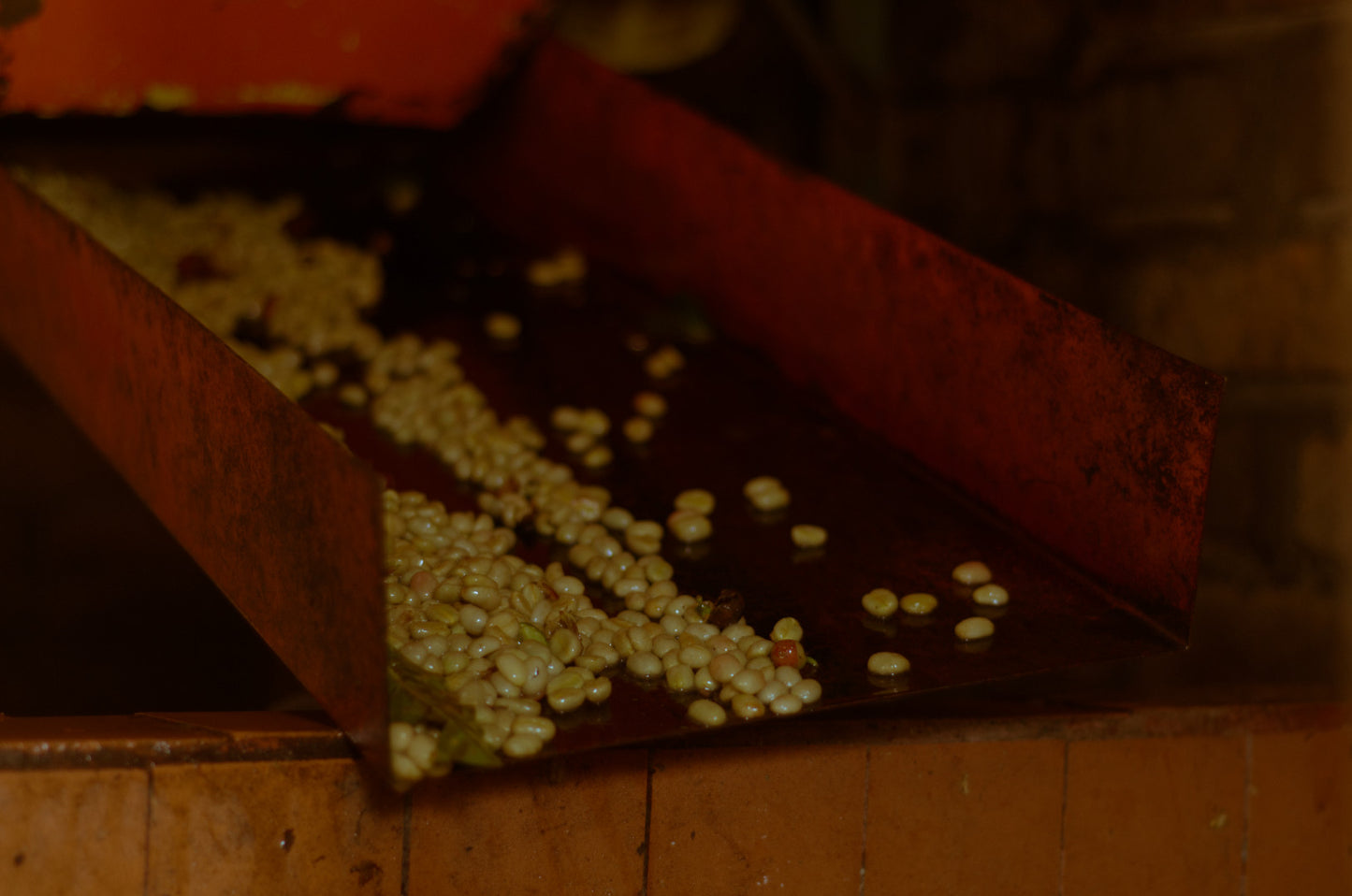
Traditional Washed: Picking very ripe to overripe cherries, with a 48 hr held in-cherry ferment before de-pulping. Parchment dry fermented for 48 hrs before washing, with the clean parchment dried slowly in parabolic driers. |
Import Partner: |
LaReb |
Harvest |
Crop 25/26, Arrived UK: 02/12/25. First year purchasing from Yoiner, but the second year from this plot |
The Story
With thanks to Herbert and Matcha from LaREB for providing the deep background information for this coffee.
LaReb - La Real Expedición Botánica - are a radical producer-owned export co-operative/movement. Their goal is to develop de-colonised supply chains and operate outside the typical multinational pathways of coffee, and it's a mission that's really resonated with us. By pooling together collective knowledge, financing, quality, export and import, LaReb members are able to define their own terms of engagement. It's genuinely so refreshing to work with Herbert and the team, and we know we'll only continue to grow our purchasing relationship over the years.
This is our third year of purchasing from LaReb, and this year we're working with Yoiner Mosquera, a third-generation producer whose path to quality coffee involved first understanding exactly what was wrong with Colombia's conventional coffee economy. Yoiner farms in El Portal, Palestina, on land his grandfather settled in 1949 after being displaced south from Cundinamarca, carrying Typica seeds that became the foundation of 75 years of multi-generational coffee farming. His grandfather's displacement occurred during the most violent phase of "La Violencia", the bipartisan conflict that reshaped Colombia's coffee geography between 1948 and 1958, and displaced families fled to frontier departments like Huila, claiming uncultivated baldíos under Law 200 of 1936, which granted land titles to settlers who demonstrated productive use over five years.
The migration pattern that carried Yoiner's grandfather from Cundinamarca to Palestina was replicated across thousands of families, transforming Huila from a frontier region into Colombia's leading coffee-producing department. Displaced campesinos brought generations of coffee knowledge from established growing areas, adapting their expertise to Huila's volcanic soils and abundant water sources. Palestina, officially founded in 1937 and situated at high elevation in the Macizo Colombiano, offered ideal conditions for the Typica and Bourbon varieties these families cultivated, and what was born from violence and forced migration ultimately built the small-holder coffee economy that now defines the region, with Huila now well known as a hotbed of speciality coffee production.
Yoiner grew up immersed in this coffee heritage but initially pursued a different path, training as an accountant and working for Banco Agrario, Colombia's agricultural bank responsible for providing producer credits. That position gave him an insider's view of how the financial system exploits small-holders, requiring producers to plant only FNC-endorsed varieties and methods to access credit, pushing them into unfavourable conditions that benefited the bank rather than farming families. He didn't like what he saw and left that life behind, and when his father passed away roughly six to eight years ago, Yoiner returned to Palestina to take over the family farm whilst his siblings remained outside the region with corporate careers. The family now functions as financial partners in the operation, providing capital whilst Yoiner manages production and delivers yields, a collective effort to keep the family land alive.
His initial approach to coffee production followed a common path in Palestina: buying cherry from neighbours, processing it through a gas dryer he'd built on the farm, and selling highly fermented naturals through middlemen to international buyers. For two to four years this operated as a speculative business model built on rumours of demand from buyers in the Gulf states or elsewhere, and Yoiner fermented aggressively to meet perceived market preferences for extreme processing. The gamble eventually failed when a middleman cancelled an order, leaving him with 7,000 kilograms of dried cherry he couldn't move and ultimately sold at a significant loss. That failure, combined with his banking experience observing exploitative supply chains, made him receptive when he encountered LaREB's transparent, producer-centred model approximately four years ago.
His former partners in the cherry-buying operation no longer work with LaREB. They continue to thrive in markets built around non-transparency, hype, and potentially adulterated coffees, and that approach clearly works for producers who prioritise short-term profit over product integrity. Yoiner made a different calculation. He saw LaREB's willingness to answer questions directly, explain payment delays rather than obscure them, and treat producers as partners rather than commodity suppliers, and he respected the product more than he respected the business model he'd been operating under. Herbert Peñaloza and the LaREB team also provided technical guidance that reshaped his processing approach, encouraging him to dial back the extreme fermentation he'd employed during his cherry-buying period, particularly for Gesha, which was being over-processed and obscuring varietal character. He now ferments his Rosado more heavily than his Gesha, allowing each cultivar to express its intrinsic qualities rather than imposing a processing signature across everything.
His cultivar choices are reflective of both Palestina's reputation and infrastructure. He grows Rosado because it's the signature cultivar of the region, with Santalucia where Rosado "originated" only 40 minutes away. We highlight the concept of "originated" as it's a little murky - naturally, all coffee varieties ultimately trace their lineage back to Ethiopia, and the "discovery" of new landrace varieties growing in Colombia likely has interesting roots - seedstock brought over for hybrid development and plant breeding, the mixing of collections and trading has resulted in the "re-identification" and "discovery" of varieties such as Ají and Chiroso in Colombia, 7500 miles away from their motherland.
He grows Gesha because six to eight years ago when he was establishing his operation, both varieties commanded premium prices and thrived in Palestina's conditions. When everyone around you is achieving success with particular cultivars, the logic is straightforward: you're not going to plant Catimor or Castillo when cup quality and payment are demonstrably lower. The timing aligned with Rosado reaching peak market interest, under its original "brand name" of Pink Bourbon. We continue to stick with Rosado (from "Bourbon Rosado") as there's no bourbon lineage involved - it is 100% Ethiopian wild type.
With the passing of the land to the second generation, the family divided the estate into smaller plots, each owned and managed by different family members, with the main processing and drying station situated at his aunt Marisela's house. Yoiner's family has deep connection to the community - his uncle Orlando served two terms as Mayor of Palestina around the turn of the millennium. As Marisela approached retirement, she transferred her Rosado plot to Yoiner, choosing instead to focus on community work and lower yield, high value varieties. We purchased Rosado from Yoiner this year, from the very same trees Marisela had cultivated, and his work demonstrates both respect for what came before and willingness to apply his own technical approach to processing and quality development.
The two varieties exhibit different harvest patterns that inform picking strategy. Yoiner's Gesha produces a mono-harvest with one substantial yield per year (typically October through December) followed by a minimal fly crop, and Yoiner employs only highly skilled pickers for these lots given Gesha management demands. His Rosado produces more continuously throughout the year with less defined harvest windows.
His processing methods now balance cultivar expression with controlled intervention: extended fermentation and traditional washed protocols for Rosado allow the variety's fruit-forward character to develop without overwhelming it, whilst the Gesha oft receives lighter treatment to preserve its delicate florals and clarity.
- Choosing a selection results in a full page refresh.
- Opens in a new window.