


Brew Guide:
Best Brewed with: Filter/Turbo Espresso
Best Rested: 4+ Weeks
Filter: 64g/L, 92°C when fresh; 90°C when rested
Espresso: 18g/50g/22s
We're tasting: Process heavy aromatics on the nose - we find cherry kirsch, muddled hedgerow fruits and a little bit of cascara. In the cup it's more structured with blackcurrant jam, stewed apple, vanilla and sultana, alongside dried orange. As it cools becoming more like elderberry syrup and hibiscus, with citrus/boozy grand marnier finish.
Traceability
Country of Origin: |
Costa Rica |
Region: |
Buena Vista de Rivas, Chirripó, Brunca |
Producer: |
Gerald & Wayner Acuña |
Farm: |
Los Alpes, Aromas del Chirripó wet mill. |
Variety: |
SL-28 |
Elevation: |
1500 - 1900 MASL |
Process: |
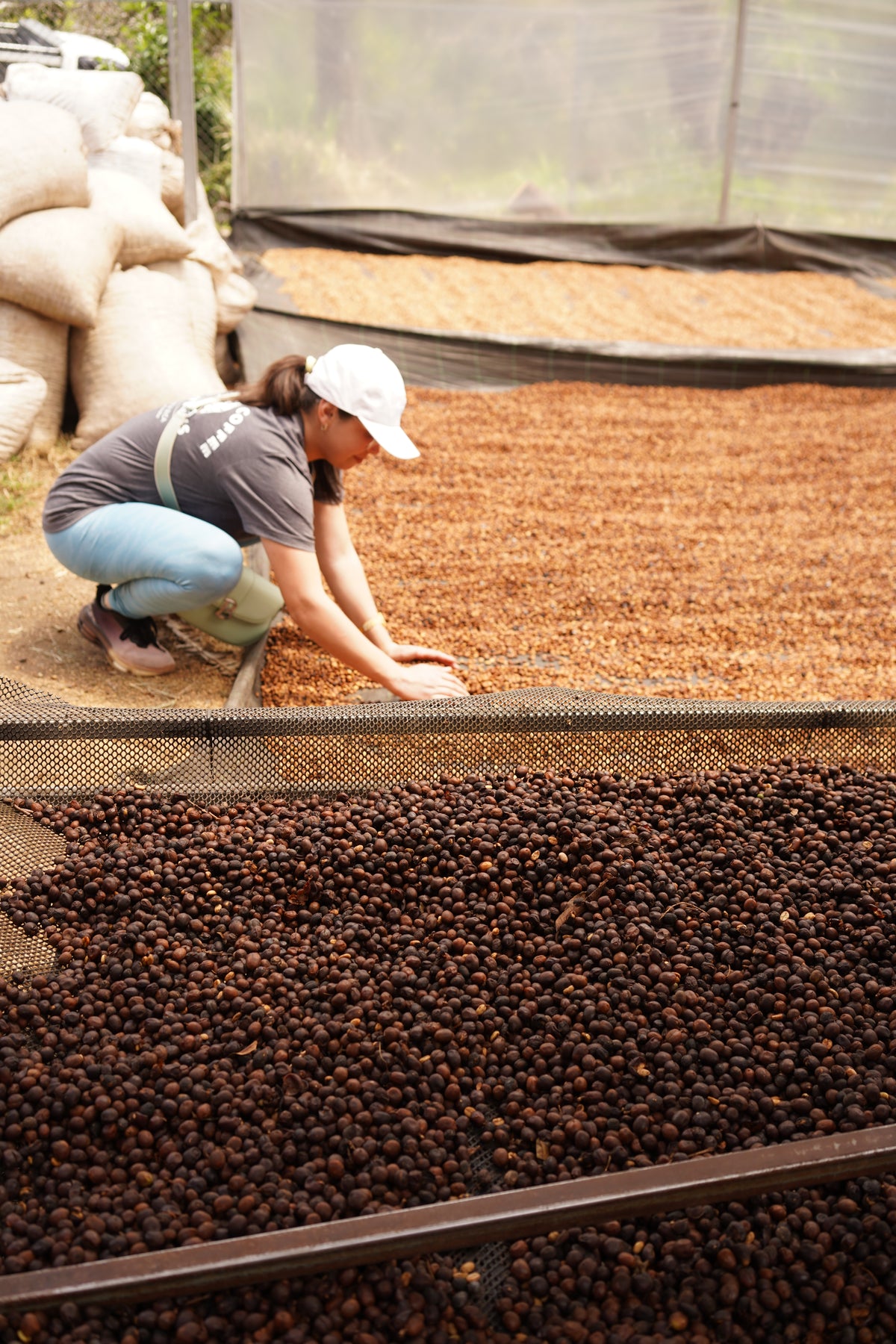
Slow Dried Natural: Ripe cherries picked as uniformly as possible and brought to the wet mill the same day or the following morning, with fermentation already underway on arrival. Fresh fruit placed on stacked raised drying beds in a marquesina, beginning on the upper levels before being moved progressively to lower levels with less sun and longer drying times as moisture decreased, with the coffee moved and checked frequently throughout. Dry milled at Corazón de Jesús. |
Import Partner: |
Selva Coffee via Sucafina |
Harvest: |
Crop 25/26. Arrived: September 2026. Second harvest purchasing from Aromas del Chirripó. |
The Story
Aromas del Chirripo is a family wet mill established in 2021 by the Acuña family in Buena Vista de Rivas, within the Chirripo micro-region of Brunca. Don Wilfrido manages cultivation whilst his sons Gerald and Wayner Acuña operate the wet mill and coordinate production, with support from their mother and sister across farm and mill operations. Their Los Alpes farm sits between 1500 and 1900 metres at the foot of Cerro Chirripo, Costa Rica's tallest peak.
In a classic example of the micromill revolution, the family transitioned from selling cherry to third-party processors to establishing their own wet processing infrastructure, using Corazón de Jesús for dry milling rather than investing in complete vertical integration. One of the reasons we return to Costa Rica year on year - and the team at Aromas del Chirripó are exemplary for this - is the veritable plethora of interesting cultivars and landraces we find being produced.
The access to interesting germplasm can be mainly traced back to the amount of agronomic research that occurs in country (relative to coffee as a whole, it's still an "orphan" crop when we compare it to staple foods grown in the global north). Of the research centres in CR, none are more famous than CATIE (Centro Agronómico Tropical de Investigación y Enseñanza), which maintains approximately 2,000 coffee accessions at Turrialba, and is a major international genebank for coffee research.
CATIE serves as the only designated "Origin Collection" outside Africa and is the sole coffee genebank participating in the International Treaty on Plant Genetic Resources for Food and Agriculture under Article 15, which establishes facilitated access arrangements for genetic material. This institutional framework is what enables Costa Rican producers to cultivate Ethiopian landraces, older "heirloom" cultivars, regionally specific landraces, and field-sampled varieties that would otherwise remain confined to their places of origin, alongside experimental hybrids developed by both CATIE and World Coffee Research.
One interesting thing that's come about from this - and we are watching this very closely - is that references grown at CATIE are sometimes the reference for a coffee variety. So an incorrectly tagged, poorly collected sample from the earlier days of coffee agronomy (see: Colonial expeditions and cultivation) could mean what we think is one variety might well be another. SL-28 - especially that grown in Kenya is one of those varieties that is perhaps throwing up some interesting results (as Lance Schnorenberg from Sey has been looking into) and we're very curious what will come from that. But a rose by any other name would smell just as sweet - if what we think is SL-28 globally is something else, but they're the same something else? it won't make the coffee any less tasty. In the meanwhile, if it walks like a duck and quacks like a duck... We love a Costa Rican SL-28 and tend to jump on it when we hit a good one. Beyond any genebank seeds, there is also the locally adapted "San Roque Kenia" - Kenyan seeds thought to be from SL-28 have been grown and passed around enough in Costa Rica to be considered a further cultivated line. The variety does well in this country - the same deep rich red & purple fruits as Kenya but generally lower acidity, but the climate and processing techniques tend to be much more suited to high grade naturals in Costa Rica compared to Kenya. We're delighted with this lot from Aromas del Chirripó and are glad to feature it
- Choosing a selection results in a full page refresh.
- Opens in a new window.