


![Ecuador - Mario Hervas' Mejorado FW [25/26]](http://scenery.coffee/cdn/shop/files/ecuador_mario_hervas_fw_shopify.png?v=1776428806&width=1445)


Brew Guide:
Best Brewed with: Filter/Espresso
Lightest Roaster Influence: We've always found Mario's coffees benefit from a slightly less aggressive heat application - stretching the overall roast time out slightly. We've taken the learnings from the honey process and applied them to the washed, with a tweaked end - slightly longer development for a cooler end temperature.
Best Rested: 4 weeks+
Filter: 60g/L, 96°C when fresh but when well rested you can go down to 92-93°C
Espresso: 18g/48g/20-22s. Brilliant turbo/soup.
We’re tasting: Intense white florals - jasmine and mexican orange blossom lead the aromatics, alongside butterscotch and mandarin zest. In the cup it's super juicy, reminding us of donut peaches, ripe comice pear, ripe tarocco blood orange, candyfloss grape & vanilla pannacotta. As it cools the florals become more dense, and the acidity shifts from citric to malic - reminding us of poached rhubarb & rose, with a panela sweetness.
Traceability
Country of Origin: |
Ecuador |
Region: |
San Jose de Minas, Nanegal, Pichincha |
Producer: |
Mario Jose Hervas |
Farm: |
Finca El Meridiano |
Variety: |
Mejorado |
Elevation: |
1350-1500 MASL |
Process: |
Double Washed: Hand picked, floated and re-sorted at the collection point, held in cherry in water for a 40-44 hours ferment before pulping. Parchment dry fermented for 18-22 hours (in Mario's new stainless steel tanks), before washing clean. Dried on raised beds inside parabolic driers.
|
Import Partner: |
Direct / Makicuna [two shipments] |
Harvest |
Crop 25/26, arrived UK: February 2026 + March 2026 [two shipments] Third harvest purchasing coffee from Mario
|
The Story
Mario knows exactly what he wants to produce - his focus for the last 14 years has been on the selective breeding and phenotypic expression of the varieties he grows on his farm, first perfecting his Mejorado plants and now working on Rosado & Gesha. He produces exceptionally clean & sweet coffees that present the cultivar expression front and centre - always the focus has been on being able to taste the cultivar, taste the environment in which it was grown. Last year was tricky weather - and while his washed lot had all the florals and citrus we expect from Mario's Mejorado, it was reflective of the season's conditions with slightly less structure and intensity than the 23/24 crop. We're very happy to say the 25/26 crop is a firm return to form - we think one of the best yet.
We can speculate - slightly - on the swap from concrete tanks to stainless. Stainless has far lower thermal mass than concrete, and as Mario ferments under shade they'll track cooler ambient conditions through the evenings rather than holding onto accumulated daytime heat (with the counterpoint- they are more likely to warm up during the day). Stainless steel is inert, easier to clean between batches, and offers more precise control.
El Meridano:
Thanks to his previous career as a rose farmer and agronomist, Mario has turned his experience towards obsessive improvement of Finca El Meridiano since starting the farm in 2011.
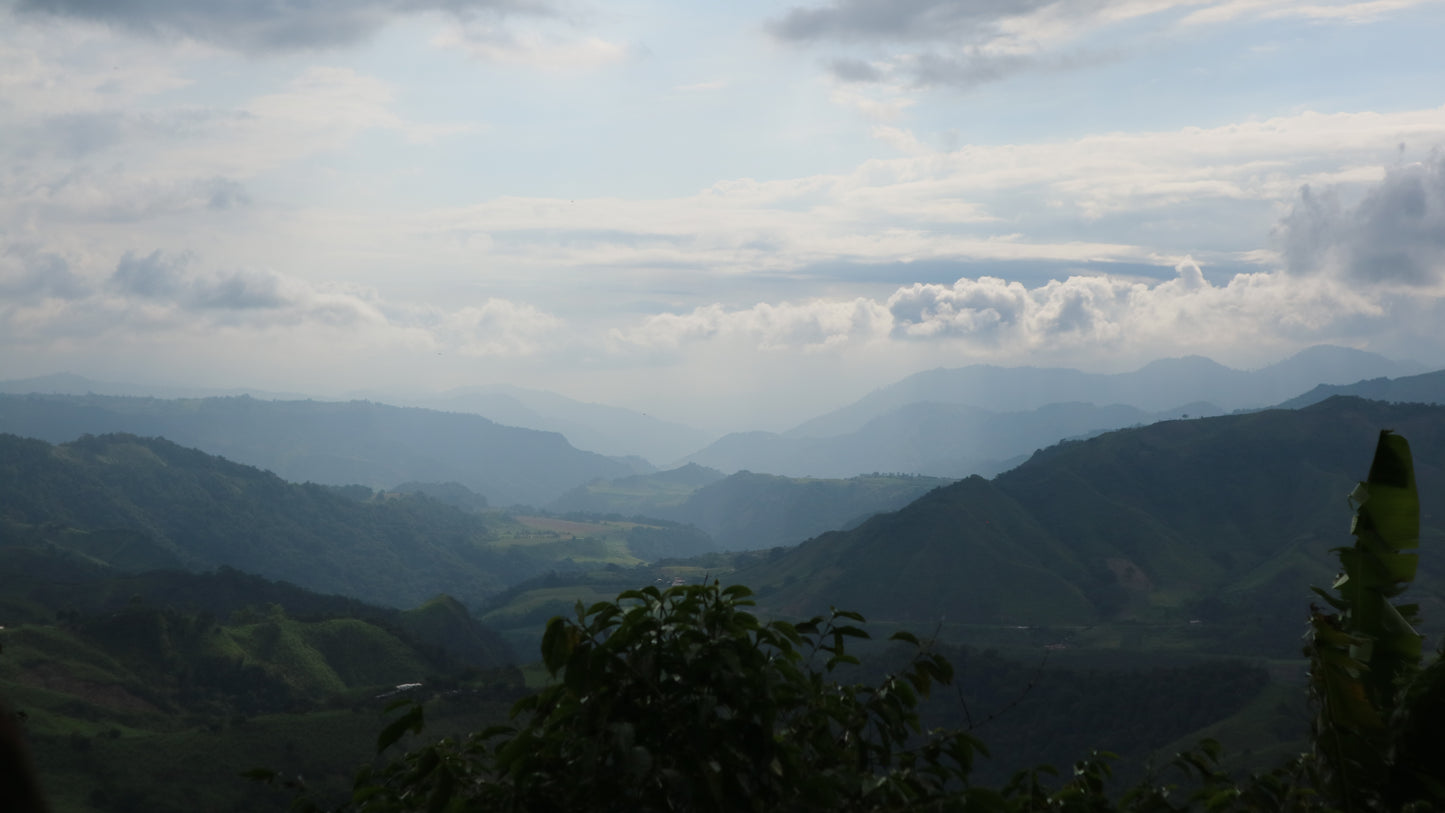
The 25 HA Finca El Meridiano sits in the stunningly biodiverse and thriving cloud forests of Nanegal, in the foothills of the Andean mountains. The climatic conditions around Pichincha means farms receive high rainfall and a relatively high humidity, which can make for a tough environment for certain varieties and cultivars of coffees more adapted to drier climes.
Mario tells us the first six to seven years of running the farm were tough and that he made many mistakes in the process of learning about the art of growing, processing and selling coffee, but he stuck at it - and while each year brings new challenges and learning, it’s started to pay off - like taking 10th place in the inaugural Ecuador Cup of Excellence, for a start.
One of the things Mario credits for his success is his nursery and breeding program. The “Mejorado” cultivar has its history in a Nestle variety garden, and is a cross between Bourbon and an Ethiopian landrace (likely for the purposes of hybrid vigour, improved yield and quality). This variety is gaining a strong reputation for quality - deep sweetness, florality and complexity when grown well.
Mario has germinated, selected and bred every single tree on the farm. By selecting only those Mejorado trees that performed well in Meridiano, the 10 HA that are planted with coffee are strong, healthy, high yielding and of impeccable quality. The coffee from Meridiano is incredibly consistent - and considering the impacts of climate change and general natural variability, it’s no mean feat.
Scoffing at the thought of funky notes from processing, Mario has been tweaking his washed process (and more recently white/yellow honey process) to bring out the cleanest expression of the land and cultivar. One aspect he credits for the quality of the fermentation is the quality of the private springs that provide the farm water.
Mario’s coffee comes with a price - that we think is more than fair to pay. Ecuador is a dollarized economy, which broadly means their internal goods and services (including labour) are more expensive when compared to neighbouring countries. One of the biggest challenges in running a speciality farm in Ecuador is the labour to pick the cherries. Seasonal itinerant labour is reduced in Ecuador, as many who would undertake it have migrated north in search of economic empowerment. While Mario pays more for quality, it can be hard to retain pickers - to the point it is almost better to pay someone who picks poorly (and re-sort the cherries at the collection point), than to force the issue and have them not turn up the next day.
There are never enough pickers to get all the cherries on the farm - so Mario’s focus to ensure his farm is profitable is on adding value through quality, rather than bulk quantity.
Having worked on the Mejorado project for some time, Mario is turning his attention to Rosado and Gesha - although he says there is some work to be done yet to select for the genetic expression he is looking for. We’re very excited to see what he cooks up - we’ll try and be first in line for the early harvests, that’s for sure - we're hearing the 26/27 crop could see the first pickings come to fruition.
- Choosing a selection results in a full page refresh.
- Opens in a new window.