




Brew Guide:
Best Brewed with: Filter & Turbo Espresso
Lightest Roaster Influence: Dense, well sorted Ethiopian naturals can take heaps of heat and a snappy roast - more processed coffees tend to want a softer approach and low end temp/short dev time. We split the difference and we like it - trying to get as close to peak aroma/acids without teasing out any extra funk.
Best Rested: 4+ Weeks
Filter: 64g/L, 91°C when fresh; 88°C when rested
Espresso: 18g/50g/18-22s
We're tasting: A big high energy process forward cup - we're finding pineapple, yuzu, and berry aromatics. In the cup it's boozy and mega sweet - we're finding it quite like a sabayon, with macerated summer fruits (raspberry, blackcurrant, blackberry) and boozy custard, alongside white chocolate. As it cools the process note evolves to the wilder and brighter fruity notes of a pét nat wine - with white grape, pear, apricot and nectarine, and the floral tartness of tiger lemon.
Traceability
Country of Origin: |
Ethiopia |
Region: |
Megadu, Shakisso Woreda, Guji |
Producer: |
Dawit & Hester Syoum-Westerveld |
Farm: |
Bette Buna Megadu |
Variety: |
Wild Guji Megadu (local landrace), JARC 74112/74158 |
Elevation: |
2000 - 2200 MASL |
Process: |
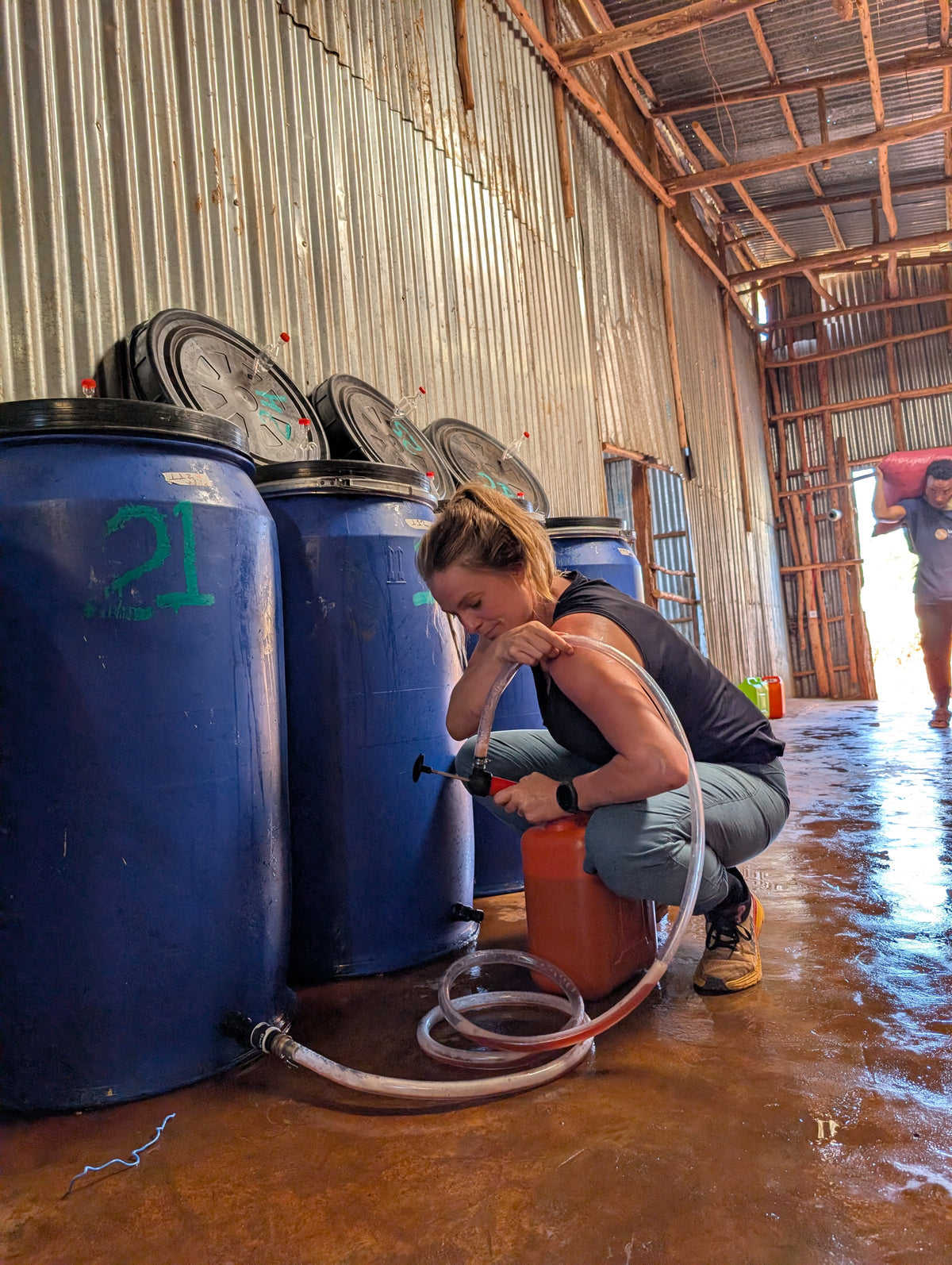
Yeast Inoculated Anoxic Natural: Ripe cherries selectively picked and sorted before being placed on raised beds for 24 hours, covered with netting to prevent direct sun exposure, allowing for surface oxidation at ambient temperature. Early the following morning, when cherry temperature had dropped to approximately 10°C, cherries were loaded into hermetically sealed barrels. A starter culture of Côte des Blancs commercial wine yeast, prepared in cold water at around 12°C alongside raw sugar and nutrients, was added to the barrel at this point. Côte des Blancs is an aromatic strain selected in France for producing expressive, fruit-forward white wines; in this application it was chosen for its ability to enhance floral and fruity esters, and it performs most expressively in fermentation environments below 17°C. Cherries fermented anoxically for 96 hours under shade (maintaining an cooler environment), with fermentation liquids recirculated every 24 hours and close monitoring of pH, temperature, and °Brix throughout. Fermentation was stopped when pH reached 4.2 and °Brix had fallen to approximately 10. Cherries were then dried on raised beds post-ferment. |
Import Partner: |
Direct with Bette Buna (facilitated via Falcon) |
Harvest: |
Crop 25/26 - Arrived UK 01/07/26. Third year purchasing from Bette Buna |
The Story
Bette Buna have spent this down-cycle year (with low cherry availability, staggeringly high internal prices and high cost of production including fuel scarcity) focusing on two things - processing value-add, and systems improvement, and it's from this focus we've selected our second release of the new season Ethiopians.
This year's production included 4 pathfinder processing experiments. Lots A, B & C involved the inoculation of commercial yeast strains, and Lot D, our previous release left the endogenous wild yeast and instead inoculated with a lactic acid bacteria culture used for making sour beers.
Lot-B - using "Côte des Blancs" yeast (S. Cerevisiae) - jumped out to us for the sweetness and intensity of unique flavours when we cupped it in Addis, and for that reason we selected it as the final special prep from Megadu this season. One of the reasons that specific, coffee adapted yeasts (such as the Lalcafé range) were developed was to deal with the hot fermentation temperatures found in producing countries. Many commercial yeasts developed for wine and beer perform best at lower temperatures, and get stressed and produce off-flavours when fermented hot, which is why they're often only used with good results by coffee producers with complex fermentation vessels that can control and reduce temperature, or temperature controlled rooms.
Bette Buna approached this challenge in a pretty smart way -
Their first time working with commercial yeast cultures, they decided to run the series of experiments fixing nearly all the variables they could - especially time - with the only changes being the strain of yeast used and trying to match the temperature recommended for the strain. Lacking bioreactors or air-conditioning in rural Guji, they took advantage of the diurnal temperature swings - starting fermentation very early in the morning with cold cherries and relatively cool water for the yeast starter, and keeping the fermentation barrels under shade indoors for the duration - thanks to this they were able to keep the ferment at the 17°C that is optimal for the Côte des Blancs yeast.
We think this is a super interesting route that's produced unique results, and the team have come away with a lot of experience in this style of production - and some more technical experiments to run for the next season. We're very excited to see how the processing develops, we think Bette Buna is doing some of the most exciting stuff in Ethiopia at the moment - super high impact work combined with value add processing, something we're really happy to champion as our key Ethiopian supplier.
Bette Buna:
The first Bette Buna (“House of Coffee”) farm was founded in 2019, after Dawit inherited his grandfather’s coffee farm in Sidama. Dawit’s grandfather was a respected community leader, and with that in mind Hester and Dawit set out to create a sustainable, community led future for coffee farming in Ethiopia. They intend to achieve this by producing higher quality coffees, with collaboration and community development intimately linked to this. The funds from fair pricing and export help pay for community education and increased living standards, with living incomes a pillar of the Bette Buna mission.
Dawit and Hester have been purchasing the farms immediately abutting the Taferi Kela farm, adopting a high standard for purchasing (a minimum price for the land, alongside paying out 2 years of future production profits for the land at the point of sale), alongside offering the farmers employment at Taferi Kela.
By acting as a vertically integrated supply chain and increasing the export value of the centrally processed coffees, this both increases the income of the farmers turned employees beyond what selling their cherry to a station might have done, and socialises the profits whilst removing personal risk. Bette Buna have also established a nursery at Taferi Kela, distributing both improved JARC cultivars (higher yielding and more disease resistant) as well as shade trees and staple food crops, providing stable and consistent year round employment to the local community.
The impact of this nursery in terms of livelihood for subsistence farming cannot be understated, and the return to agro-forestry by increased shade tree planting is a positive move on a warming planet, and the distribution is directly tied to agronomic training workshops that help further increase yield and quality (and income) to boot. The work to establish more shade trees is hand-in-hand with a rewilding project to increase the native forest cover in the immediate area around Taferi Kela, and we expect to see this region increasingly start to get prestige off the back of their work.
Dawit and Hester’s second farm (the farm this lot hails from) is located in Guji, a region that has become famed for the particular quality of the natural process coffees produced here. Coffees from Guji are deeply fruity and berrylike, something we particularly enjoyed as a contrast when compared to the tarter citrus and white flower cups that you might find in Yirgacheffe or Sidama coffees.
The provenance of Ethiopian coffee regions is really not unlike that of the different wine regions in France - particular combinations of altitude, microclimate and the local predominance of local landraces vs locally improved cultivar plantings (akin in effect to the different varieties of grapes you might find in the wine regions) shift the cup profile. Fruit flavours are a real highlight of Ethiopian coffee - from the lower grade lots that intermingle with chocolate and spice notes, to the highest grades that are so outrageously sweet, bright and floral that prior to high technical intervention coffee used to be the main gateway into discovering speciality coffee. We think that Ethiopia is such an under-valued origin - the same cup profile from a high altitude farm in Central or South America would command a hefty premium.
The Megadu farm in Guji is over 220 HA, lead by 3 community leaders (Abbaa Gadaa). Of this 220 HA, Bette Buna manages a quarter, acting as a pilot project for many of the community lead initiatives Hester and Dawit run. The processing station, located centrally in the farm, allows high value return processing (such as anoxic fermentation and extended ferments) alongside well executed classic processing, and crucially drying. Both farms produce their own coffee for production, but also purchase cherry from local smallholders for onwards processing.
- Choosing a selection results in a full page refresh.
- Opens in a new window.