


Brew Guide:
Best Brewed with: Filter
Lightest Roaster Influence: We're still refining our approach for the PB grade - the very dense and small seeds taking on heat in a different way to the larger AA/AB beans we typically release. As ever with Kenya we're going for screamingly fast roasts (but for the PBs, with a slightly lower maximum inlet temperature) and aiming to get the best internal development at the lightest roast degree
Best Rested: 4+ weeks
Filter: 62g/L & 96°C, with rest we like to move down to 93°C and 60g/L
Espresso: Turbo shots + 3 weeks rest. 18g/48g+ & 20s
We're tasting: Really classic Kenyan aromatics - blackcurrant & apple cordial, some floral black tea like darjeeling. In the cup it's like hot vimto - all the purple fruits, with a hint of baking spice and pomegranate molasses, alongside lemon verbena and a floral note that reminds us of parma violets. As it cools, the acidity resolves to a really juicy malic note like poached rhubarb. Emblematic of type
Traceability
Country of Origin: |
Kenya |
Region: |
Kerugoya and Kianyaga, Ngiriambu District, Kirinyaga County |
Producer: |
3700 Smallholders, Thirikwa F.C.S |
Factory: |
Gakuyu-ini |
Variety: |
SL-28, SL-34, Batian, Ruiru 11 (PB screensize) |
Elevation: |
Farm Elevations 1500 - 1900 MASL, Station Elevation 1572 MASL |
Process: |
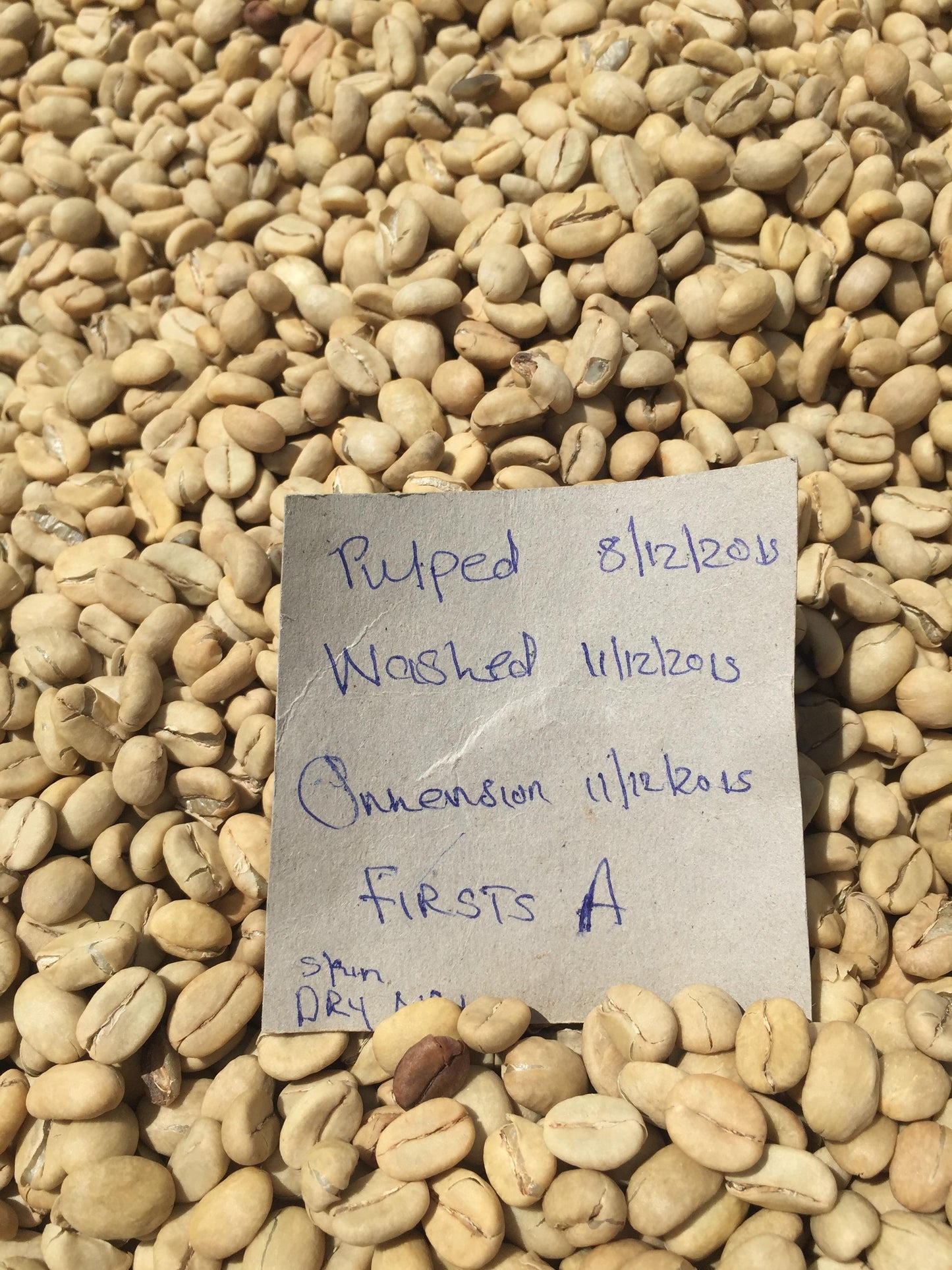
Traditional Washed: Selectively picked cherries are delivered by smallholders to Gakuyu-ini Factory, where they are sorted at intake, then pulped in the afternoon with the parchment fermented overnight. The parchment is then washed with density sorting, with the top grades sent for a secondary soak in fresh water of around 16 hrs, before moving to raised beds to dry over 8 - 14 days, weather dependent. |
Import Partner: |
Nordic Approach via Dormans |
Harvest |
Crop 25/26, Arrived UK April 2025. New Purchasing Relationship
|
The Story
Kenya 25/26 Crop:
If one thing could be said about the 24/25 crop of Kenyan coffees, it would be this - a stunning return to form with classic flavours, we felt like we were practically tripping over banger lots after many years with a dearth of great selections. This year as an industry of roasters we felt like we were waiting with baited breath to see if it was a flash in the pan - we're ready to call it - it's another banner year
The 2025/26 Kenya main crop marks a production rebound from a smaller 2024/25 season, driven by biennial cycles and price-incentivised improvements in farm inputs across the cooperative sector, which high coffee prices in the last few years have supported.
We've seen regulatory upheaval in the last few years in Kenya - 23/24 saw a wholesale shutdown of the entrenched system due to purported corruption and monopolistic behaviours - with a few seasons to shake out the changes since then, with the balance of power and regulation swinging a few ways back and forth, things are back to ticking over, quality is good, and coffee is moving on time.
President Ruto assented to the Coffee Act 2023 in March 2026, re-establishing the Coffee Board of Kenya as the sector's principal regulator and introducing a new export levy framework. A concurrent High Court suspension of the government's Direct Settlement System, a payment reform that would have routed auction proceeds directly to individual farmers rather than through cooperative societies remained in effect at the start of the season, leaving payment flows through the established cooperative model.
While AA availability has been good this year, there's less AB lots and below. Nearly all the samples we tried this season have been bangers, and early fears of a restricted harvest has seen many exporters/importers commit early and ship early - expect to see a flow of lots starting now and gracing both our offer sheets and other roasters.
Gakuyu-ini/Thirikwa F.C.S:
Gakuyu-ini is the sole wet mill of Thirikwa Farmers' Cooperative Society, situated in the Ngariama location of Gichugu Division, Kirinyaga County, on the southern slopes of Mt. Kenya.
Member farms span the catchment villages of Githiru, Gituba and Mukure, ranging between 1500 and 1900 metres above sea level. The cooperative's roughly 3700 registered smallholders farm predominantly sub-hectare plots, as is typical for smallholder Kenyan production, with SL28 and SL34 as the dominant cultivars alongside Ruiru 11 and Batian.
Operating a single factory is relatively unusual among Kenyan cooperatives, and one the cooperative has parlayed into some of the strongest farmer returns in Kirinyaga County - Gakuyu-ini has a great reputation and therefore fetches high prices at auction, and internal competition amongst factories incentivises high farmer payouts. Sometimes this prevents co-operatives reinvesting in themselves - because without cherry to process, there is no income. It's a tricky balance that needs to be carefully managed by good co-operative mangaement
Screen Sizing During Milling/Kenya Grades:
After drying and hulling, Kenyan coffee is graded at the dry mill by screen size (effectively sieves with progressively smaller shaped holes that sort by size) and density. The principal commercial grades are AA (screen 18 and above), AB (a combined grade spanning screens 15 through 17), and C (below screen 15, typically representing lower density or imperfect beans). Peaberry, or PB, is separated as a distinct category: it occurs when only one seeddevelops inside the cherry rather than the usual two, producing a single small, rounded and notably dense bean in place of the characteristic flat-sided pair, which can be screened by changing not the size of the holes but the shape.
Because the grade is defined by bean morphology rather than screen size, peaberry lots from a given factory carry the same provenance as the AA from the same harvest, and typically represent around 5 to 10% of milled output.
- Choosing a selection results in a full page refresh.
- Opens in a new window.