


Brew Guide:
Best Brewed with: Filter, would be fine on espresso with a bit of rest.
Light Roaster Influence: With this coffee, we identified that the cup profile would be improved if we extend the roast a little further than our typical lightest approach, adding the brown sugar notes that come from extra time in the roaster to support the cup profile. A little more soluble as a result
Best Rested: 2-3+ weeks
Filter: 64g/L & 91°C, with rest we like to move down to 89°C
Espresso: Trad shots, 18g/44g+ & 29-33s
We’re tasting: Super interesting aromatics - we're finding fresh grated nutmeg, cola cubes and bruised plums. In the cup it's hedgerow fruits, strong brewed rooibos chai, fruitcake and fig rolls, with a demerara sweetness. As it cools becoming a little more red-fruit forward with shortcrust pastry notes, almost like jammy dodger biscuits, and the nutmeg spice aromatic evolves towards a hint of fresh cedar and pu'erh tea.
Traceability
Country of Origin: |
Rwanda |
Region: |
Nyamasheke District, Western Province |
Producer: |
500 Private smallholder farmers selling cherry to Cyesha, Muraho Trading Company |
Station: |
Cyesha |
Variety: |
Red Bourbon |
Elevation: |
1450 - 1800 MASL |
Process: |
Traditional Natural: Cherries hand sorted, floated & underripes skimmed. The cleaned cherry is then laid out to dry on raised beds, and slowly dried over 50 days - with continual hand sorting, and turning during the hottest parts of the day. |
Import Partner: |
Raw Material |
Harvest |
Crop 25/26, Arrived UK Dec 2025 Second harvest purchasing coffee from Cyesha smallholders. |
The Story
The vast majority of Rwanda's smallholder coffee farmers are tending plots that are fractions of a hectare, and the trees on it are oft the household's primary cash crop, with the rest of the land dedicated to subsistence farming.
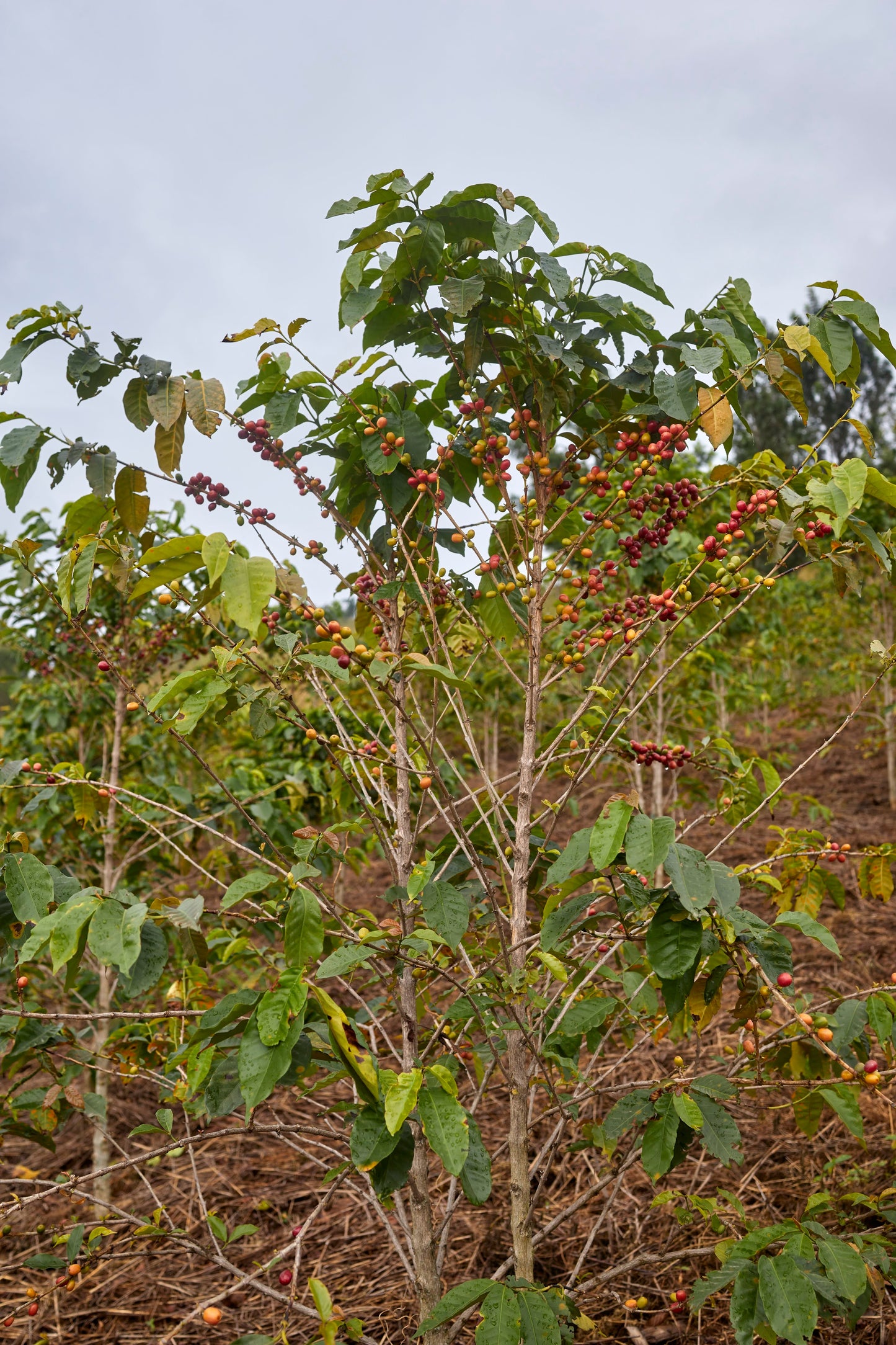
Coffee trees take several years to reach peak productivity (atleast 2 years from germination to flowering, often 3), and decline significantly in productivity with age, as the nodes along each branch can only fruit once. Over time, productive growth is pushed further out towards the branch tips while the interior wood becomes spent, and the tree's capacity to set fruit diminishes season on season.Pruning and stumping can reset this cycle by forcing new vegetative growth with fresh fruiting nodes, but for a smallholder reliant on a single cash crop, taking a tree out of production for one or two seasons is a serious financial decision.
In addition, achieving continual productivity year on year - especially as coffee trees can live for decades - requires eventually refreshing the nutrients available in the soil; and agrichemical inputs are exorbitantly expensive for the average smallholder. It would be true to say that the majority of Rwandan coffee production is unintentionally organic, and could be certified if it was not for the expense attached to the very same process.
Raw Material have the mission statement of maximising producer income - and with Muraho, their approach to this at Cyesha (and many of their other stations) is built around three interventions. Coffee pulp discarded during processing is combined with grass cuttings to produce an organic compost, which is redistributed to contributing producers at no cost. This gives farmers access to soil nutrition that can help increase the productivity of their trees, which can especially help off-set the "up" and "down" years that happen when a coffee tree expends too much energy on a bumper crop and takes a low yield year to recover.
The second track is the distribution of tens of thousands of new seedlings for free each year, and the station's team works with producers on pruning and stumping of older stock - in training how, and encouraging them to do so.
The speciality market plays a direct role in making this work. When coffee is traceable to station level, and sold at speciality pricing rather than moving through commercial channels, the value returned is large enough to fund second payments to producers based on the quality of their cherry at export. That difference in price is what allows a station like Cyesha to reinvest in composting, seedling distribution and agronomic support without simply absorbing the cost as charity.
Over time, the cycle is intended to be self-reinforcing: healthier, younger trees produce better cherry in greater volume, which fetches higher prices, which funds further investment at farm level, maximising producer income.
- Choosing a selection results in a full page refresh.
- Opens in a new window.